Description: The video consists of interviews intercut with observational footage of residential homes and patients and social care workers, e.g. nurses, doctors, etc. concerning the state of social care and the effects of NHS wards closing and the privatisation of rest homes. There is intermittent narration within the video, a male voiceover giving information about government policy.
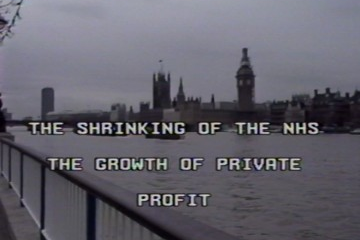
The video opens with an elderly woman with the subtitles "A Happier Old Age?" followed by the title-card (TC) - "The Shrinking of the NHS, the Growth of Private Profit" followed by a zoom into the Houses of Parliament.
The narrator describes a white paper titled 'Government Expenditure Plans 1985-86 and 1987-1988' and how this allows funds to be moved from health authorities to alternate forms of care.
A women in NHS ward care describes her quality of life, saying that she enjoys the company of the ward and the importance of her being able to communicate with friends and family outside of the ward.
A social worker from the Department of Medicine for the Elderly describes how institutional care has room for improvement but isn't entirely bad.
A nurse at Brighton General in the Long Stay Ward describes the variety of medical and therapeutic services they provide in hospital and how it will be a shame if the wards close because elderly service users might be relegated to single rooms with lacking services.
A home-visit speaks about the pressure on elderly people to enter private nursing homes, which she says is frightening because geriatric medicine is a precise speciality and elderly people may not receive the best care in private settings.
A consultant physician in the Department of Medicine for the Elderly compares their 360 beds to the rest of the regional district, stating they are 'bottom of the league'.
An interviewer talks to a patient about moving to private nursing homes, she talks about the the benefits of having company in the wards. Another talks about the savings that would be used up in private nursing homes.
TC: Public Funds to Private Pockets
A director of a private residential firm speaks of the profit incentive in expanding his elderly care business, buying one home a year.
A doctor speaks about how private homes lack a therapeutic value that hospitals do have.
A community nurse argues that private nursing homes are run purely for profit and that owners would run them 'on a shoestring' to maximise profits.
The narrator states that health and local services are deliberately funnelling elderly patients into private care.
A rehabilitation nurse speaks about the need to be selective about who is placed in a private residential care, suggesting that it isn't appropriate to place someone who is forgetful or unable to look out for their own interests in the care of non-medical staff.
We see two elderly women residents of a private care home, one of whom appears very confused and is asking for help.
A woman nurse auxiliary describes how difficult it is for residents in private care homes to be made comfortable and how they are left in deeply uncomfortable conditions.
The narrator describes, 'A Happier Old Age' published in 1978, which formed the basis for the new white paper the film is reporting on specifies three grounds: 1. 'a retirement should not mean poverty'. 2. 'There should be a commitment to keeping people in their own homes'
3.'we should enable elderly people to make choices about their own living conditions'. The sequence is intercut with interviews with people sharing experiences which go against these principles.
TC: Community Services at Breaking Point?
An interview with an acute ward nurse where she speaks about modern challenges in community care, such as of support from extended family with everyone having to work more to contend with the cost of living.
A male general practitioner is interviewed and admits that health system is failing elderly people and that hundreds in the local area are not known to the local health services.
Interview with an elderly man who is an NHS home-based patient, describing an experience of waking up confused and unable to see, until being found by the neighbour.
TC: Cost of Life or Quality of Life?
A man is interviewed and speaks about the need for investment in resources to make at-home care work, while a nurse talks about a case where are elderly couple became unable to care for themselves at home and urgently needed to go onto a long-stay ward. We hear from another nurse that access to beds can often be delayed.
The narrator speaks about the stated government aim to meet the growing demand for services related to the care for elderly people. We then cut to an interview with a home-based elderly woman patient and her nurse. The nurse describes how it took 3 months and 7 falls before this elderly woman was finally brought onto a ward. The nurse emphasises that the need it 'desperate'
The film ends with closing thoughts from several interviewees, including a nurse who stressed that before the wards are closed there is a need for serious investment in 'back-up' options to allow for people to be cared for in the community.





Comments