Description: A documentary about the issues in council housing in Moulsecoomb-by-Sea in 1984. There is audio of two men discussing a door-to-door survey by the Birdham Road Housing Action group on the condition of council housing throughout the video. One of the narrators roleplays as a man on the council and the other brings up the survey and the issues brought up in them.
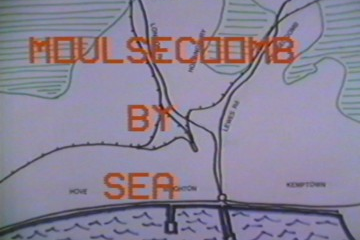
The film starts off with a scene of a Ferris wheel over flute and guitar music before transitioning to a title card - "Moulsecoomb By Sea" overlaid over a hand drawn map on a whiteboard before transitioning to an shot of a pier.
The narrators talk to one another about the issues brought up in a survey by Birdham Road Action Group, such as cars on both sides of the road, fast busses on the road, the lack of fencing in front of houses and the houses' general need for repair.
A narrator speaks about 50% of the houses need repairing.
A couple talks about the dangers in the road and how their child was in danger because there was no fence in the front garden.
The narrators talk about how there were 81 cases of dampness, some having black mould, followed by accompanying shots.
A woman talks about how when there was scaffolding placed, tiles were dropping into the loft into the loft, creating cracks in the ceiling.
A man talks about how he became depressed about his living conditions, how the council doesn't help him replace his toilet and how he feels that he is fighting a losing battle. This is interspersed with images of depilated interiors, such as badly fitted doors, windows, shots of mould, damaged walls and peeling wallpaper.
There is a shot of a pretty park and street then back to council houses.
The two narrators talk more about the survey, one says that nineteen homes have bad wiring and dangerous power points, e.g. sockets hanging off the walls, 29 homes have insufficient power points forcing them to overload the circuit.
The scene switches to a man showing the dangerous power points.
The narrators discuss freezing homes and how one parent families can't afford heaters and bills for the heaters and how paraffin heaters are dangerous for children and the elderly. He states that 31 houses with only one coal fire, 24 heated with only gas fires, 24 homes heated by electric fires,
The couple return and talk about how there's no heating in the rest of the house, how they can't afford to heat the bedrooms with electric heating and there's only coal fires in the main room.
The narrators state how 45 houses have substandard kitchens, sixteen have butler sinks which the narrator says is health hazard. He also mentions how many doors are off their hinges, having rotted away and how tenants fall into apathy due to terrible conditions and have no money or motivation anymore.
In an interview a woman speaks about how she is unsure if she can clean the wall outside her wall but the council won't clean the wall either. She also talks about how she fell down due to damaged paving and broke both her wrists and says how she contacted the council and it was never repaired. The interviewer asks if she was a good tenant and she says she has never been in debt to the council.
The narrators discuss the issue of overcrowding in the essay - seventeen families have five to six people in two-bedroom houses.
The couple explains their overcrowding issue - how they have three people in one room, two in another room, three in a third room and one on the couch.
Children talk abut how they'd like a large adventure playground but they won't get it because the council is afraid that the older children will burn it down again.
The narrators discuss waste in the area, how the council won't collect waste to put into the dump and that it is accumulating in people's gardens.
The interviewer asks a woman about what she'd like in the area if there was unlimited money and she replies by talking about how she'd like to paint the exterior of the houses, adding flowers and collecting the waste in the gardens.
One of then narrators says that not everything is bad before the other narrator asks if he would like to live in the area and the narrator finally says that he wouldn't. This is accompanied with a shot of the beach before the council houses.
The credits appear, giving thanks to the Workers Education Association and South East Arts, and stating how the film is a Barefoot Video Training Production.





Comments